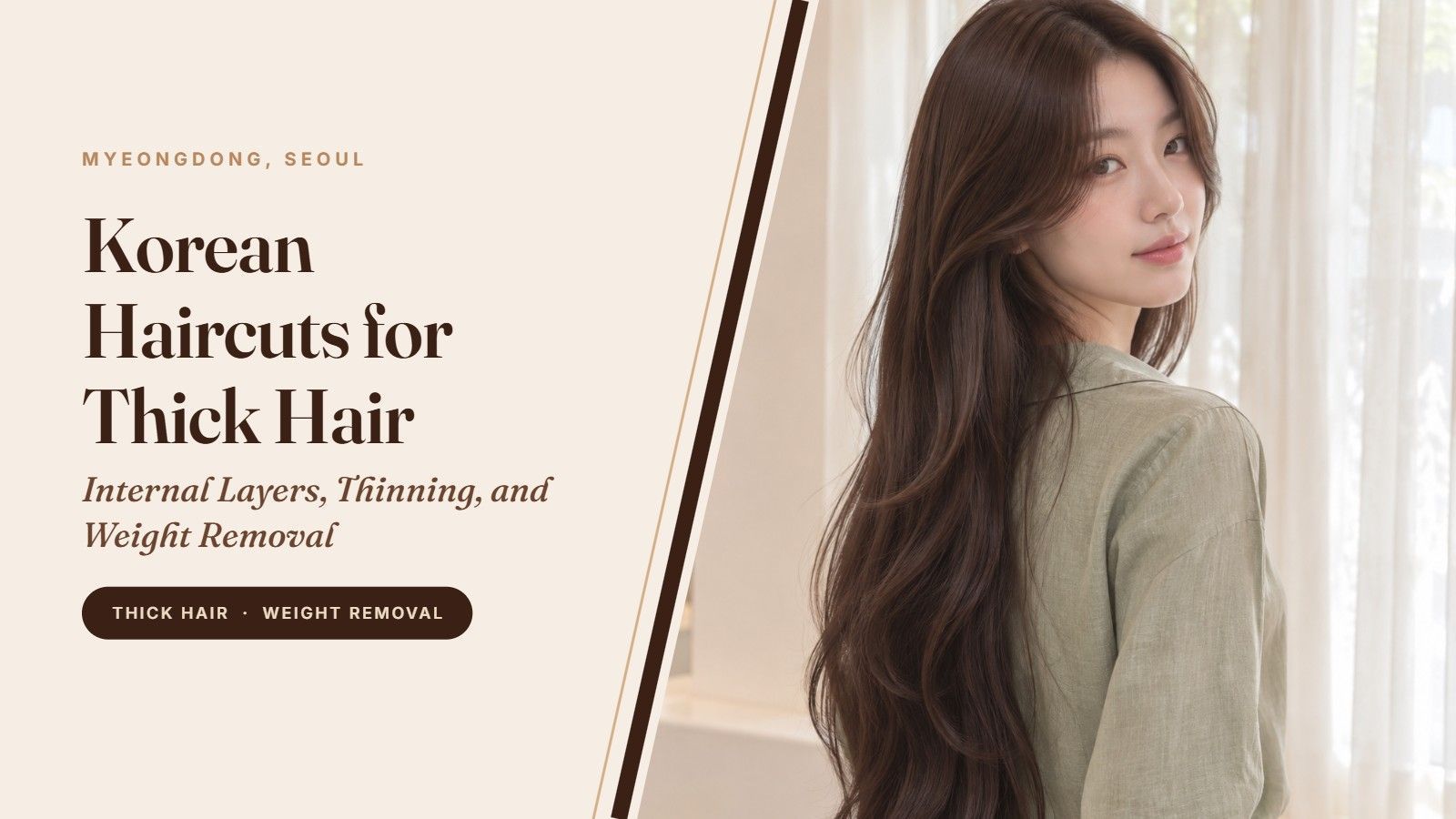
Korean designers handle thick hair in three ways: internal layers (shorter hair hidden underneath to remove bulk), thinning (숱치기, removing weight with thinning shears or a razor) and shape-based weight removal at the sides and back. Done well, thick hair dries faster, lies flatter and moves more, without the surface looking choppy.
If your hair takes forever to dry, puffs out into a triangle and feels heavy on your head, the cut needs to remove weight, not just length. Korean designers are known for handling thick Asian hair, using a mix of internal layers, thinning and shape control. This guide explains each technique, how to choose the right one for your goal, which Korean styles suit thick hair best, and how to make sure your designer does not take away too much.
Three ways to remove weight
Thick hair usually means high density (many strands), coarse strands, or both. Each needs a slightly different approach: high density benefits most from internal layers, while coarse strands benefit from smoothing and controlled thinning at the ends.
Internal layers
Hidden shorter sections under the top layer take out bulk while the surface stays smooth.
Thinning
Thinning shears or a razor remove hair through the mid-lengths and ends.
Shape control
Weight is reduced at the sides and back where thick hair puffs out most.
Korean salons often call the overall process 숱치기 (thinning) or 숱 정리 (weight cleanup), but a skilled designer will explain exactly where they plan to remove hair before they start.
Why thick hair puffs out
Thick hair stacks on itself. The hair underneath pushes the outer layer outward, especially at the sides and the back of the head, which is where the classic triangle shape comes from. The longer and straighter the hair, the more weight collects at the bottom.
Humidity makes it worse, because coarse strands absorb moisture and expand. That is why thick hair can look smooth in the morning and puffy by the afternoon in a Seoul summer.
Removing weight in the right places lets the outer layer lie closer to the head, so the overall shape becomes rounder and calmer. It also reduces drying time significantly, which many people with thick hair notice as the biggest everyday improvement.
Which technique for which goal
The best results usually combine two or three techniques in moderation rather than relying heavily on one.
| Your goal | Technique | Watch out for |
|---|---|---|
| Less puffiness | Internal layers + side weight removal | Too short underneath can stick out |
| Faster drying | Moderate thinning | Over-thinning causes frizz |
| Movement | Long layers + point-cut ends | Choppy ends on straight hair |
| Keep thickness at ends | Internal layers only | Ask for minimal surface thinning |
Styles that love thick hair
Airy and light
Many light layers suit thick hair best.
Rounded shape
Internal layers stop the triangle shape.
Movement with length
Weight moved to create swing.
Short sides
Removes side bulk under a longer top.
Thick hair and Korean perms
Thick, straight hair holds a perm very well, which is why it is popular for digital perms, build perms and C-curls in Seoul. The challenge is that curls add width. A perm on thick hair that has not had weight removed can look bulky and triangular, even if the curl itself is beautiful.
For that reason, designers usually cut first, removing weight with internal layers, and then perm. If you plan to get a perm on the same day, tell your designer at the start of the consultation so they can plan the cut around the curl.
Men with thick hair often combine a two-block cut with a down perm on the sides. The cut removes the bulk, and the down perm stops the remaining side hair from sticking out as it grows, which can stretch the time between haircuts.
How much weight should be removed?
| Amount | Result | Risk |
|---|---|---|
| Light | Slightly softer movement | Little change on very thick hair |
| Moderate | Faster drying, rounder shape | Usually the safest choice |
| Heavy | Very light and airy | Frizz, short hairs sticking out, thin ends |
Most designers start with a moderate amount and check the result dry. It is much easier to remove a little more than to wait months for over-thinned hair to grow back. If you have had bad thinning before, mention it clearly.
What to tell your designer
Show this to your designer
- 숱이 많아서 무거워요. My hair is thick and feels heavy.
- 겉은 자연스럽게, 안쪽 숱을 쳐 주세요. Please thin the inside and keep the surface natural.
- 너무 많이 치면 부스스해져요. If you thin too much, it gets frizzy.
- Tell your designer how you style (air-dry or blow-dry).
- Ask to check the result dry before finishing.
- Combine with a light treatment if hair is coarse or dry.
Daily care for thick hair
Thick hair stays manageable longer with a few habits. Dry the roots first so the hair does not set with volume in the wrong place, then smooth the lengths with a paddle brush. Use a light leave-in or essence on the ends to control frizz without weighing the hair down.
Sleeping on damp thick hair often causes kinks and extra volume the next morning, so try to dry it fully. In humid weather, a smoothing serum on the mid-lengths helps keep the rounded shape your designer created.
Thick hair after you fly home
The weight your designer removes grows back faster than length, so most people with thick hair notice the difference fading after about 8 to 10 weeks. If you only visit Seoul occasionally, ask the designer which areas they thinned and how, so a stylist at home can repeat it.
Taking a photo of your hair the day after your appointment, once it has settled, gives you a useful reference for how it should look when the weight is right.
Common mistakes with thick hair
- Thinning the surface layer, which leaves short hairs poking out on top.
- Removing weight only at the ends, so the middle still puffs out.
- Cutting too short underneath at the nape, which can stick out as it grows.
- Skipping a dry check: thick hair looks very different once dried.
Ask your designer to show you the inside of the hair after thinning. You should see weight removed underneath while the top layer stays smooth.
Frequently asked questions
Will thinning make my hair frizzy?
What is 숱치기?
How often should thick hair be thinned?
Is a perm a good idea for thick, straight hair?
How much does a cut for thick hair cost in Myeongdong?
Can thick hair be thinned too much?
How long does thinning last?
Key takeaways
- Thick hair needs weight removal, not just a trim.
- Internal layers remove bulk while keeping a smooth surface.
- Moderate thinning speeds drying; too much causes frizz.
- Ask for the inside to be thinned and the surface kept natural.
- Refresh every 8–10 weeks.
Prices and times are typical ranges for Myeongdong, Seoul, and can vary by hair length, condition and designer. Always confirm the final quote in your consultation. Last reviewed November 2026.