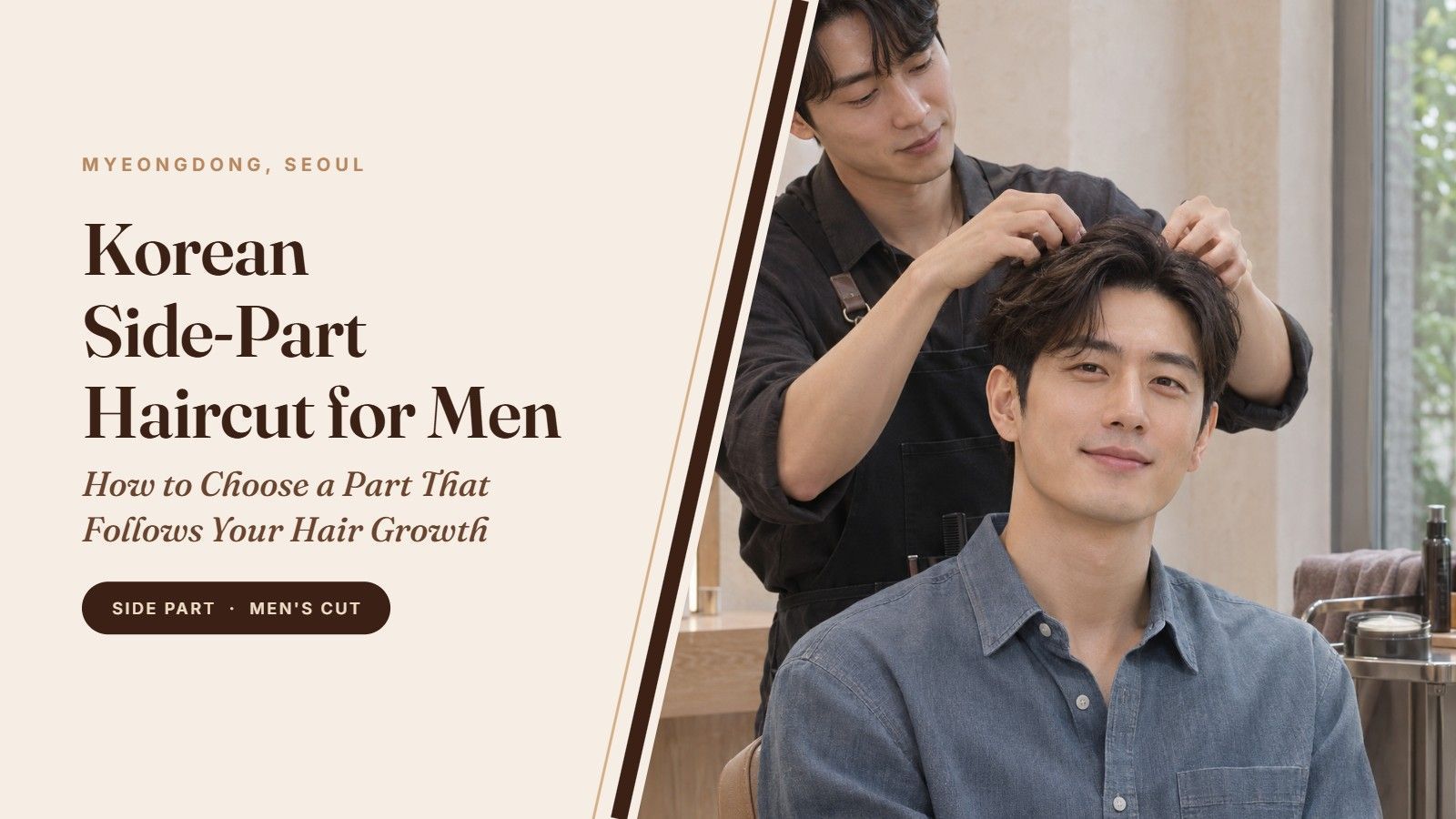
Choose the part where your hair already splits naturally, usually above the outer corner of one eye, because hair falls that way after every wash. A Korean side-part is commonly a 6:4 or 7:3 split (가르마), with the larger side swept back and up for volume. Your designer finds the natural part by combing wet hair back and letting it fall.
A side-part haircut looks effortless only when the part matches the way your hair actually grows. Force it to the wrong side and it will flip back by lunchtime, no matter how much product you use. This guide explains how Korean designers find your natural part, what part ratios like 6:4 and 7:3 mean, how the cut is built around the part, and how to keep it in place every day after your salon visit in Myeongdong.
How to find your natural part
Your natural part is decided mostly by the swirl at your crown and the direction hair grows at the front hairline. When a haircut follows that direction, hair falls into place on its own after every wash.
- Wet and comb back Comb wet hair straight back from the forehead.
- Push forward gently Hair separates where it naturally parts.
- Check the crown The swirl at your crown often pushes hair to one side.
- Confirm dry Let it dry naturally and see which side stays flat.
Why the right part matters so much
Every head has a natural growth pattern, usually anchored by the swirl at the crown. Hair leaves the swirl in a spiral, and that spiral pushes the hair at the front toward one side. When you part your hair in the direction it already wants to fall, the larger side lifts naturally and the smaller side lies flat. When you part against it, the hair constantly pushes back, so the part closes, the fringe flips and you need more product to hold it.
This is why Korean designers spend time finding the part before they cut anything. The length on each side, the amount of weight removed and even the angle of the layers are all planned around the part. A side-part cut that ignores your growth pattern can look right on the day and wrong after the first wash.
If you have always parted on one side but it never stays, it is worth asking your designer to check whether the other side matches your growth better. Many men are surprised to find that switching sides makes styling much easier.
Part ratios explained
Korean salons often describe side parts as ratios (가르마 비율). The ratio tells the designer how far from the centre the part sits.
| Part | Where it sits | Look |
|---|---|---|
| 5:5 | Centre | Curtain style, youthful |
| 6:4 | Slightly off-centre | Soft, natural Korean side part |
| 7:3 | Above the eye's outer corner | Classic, polished, formal |
| 8:2 | Far to the side | Bold, retro |
Most Korean men choose 6:4 for everyday wear and 7:3 for a more formal, polished look, such as for weddings, interviews or business.
Which part ratio suits your face?
7:3
Height on the larger side and a deeper part lengthen the face.
6:4
A softer part keeps volume lower and balanced.
6:4 with soft texture
Softens strong angles.
6:4 with fringe forward
Partial coverage balances proportions.
Your designer can also check which side flatters your face more by parting your hair both ways in the mirror. Many people have a 'better side' that matches their natural growth anyway.
How the cut supports the part
Kept longer
More length on the larger side for the sweep and volume.
Shorter and tidy
Sides can be a soft two-block so the part looks clean.
Weight controlled
Stops the swirl from lifting the hair the wrong way.
Parting perm
Adds root lift so the part holds without much product.
Asking for it
Show this to your designer
- 가르마 펌 없이 가르마 컷으로 해 주세요. A side-part cut without a perm, please.
- 제 가르마 방향에 맞춰서 잘라 주세요. Please cut it to follow my natural part.
- 6대4 가르마로 하고 싶어요. I would like a 6:4 side part.
- Blow-dry the larger side up and back, then flatten the short side.
- Use light wax or cream; heavy gel can separate the hair.
Common side-part problems and fixes
| Problem | Likely cause | Fix |
|---|---|---|
| Part closes up | Hair too soft or flat | Parting perm or root lift when drying |
| Hair flips to the other side | Part against growth direction | Move part to natural side |
| Larger side collapses | Too much weight | Light layering or volume styling |
| Short side sticks out | Sides too long or coarse hair | Shorter sides or down perm |
Most of these are solved in the cut itself, which is why the consultation and part-finding step matter so much.
Side-part haircut vs parting perm
| Side-part haircut only | Haircut + parting perm | |
|---|---|---|
| Daily styling | 3–5 minutes with dryer | 1–3 minutes, mostly set |
| Root volume | From blow-drying | Built in for weeks |
| Hold in humidity | Moderate | Strong |
| Best for | Thick hair, people who like styling | Fine or flat hair, busy mornings |
| Time at salon | 30–45 min | 1.5–2 hours |
A parting perm is optional. If your hair is thick and naturally holds a part, the haircut alone is usually enough. If your hair is fine, soft or tends to flatten by midday, the perm can make a big difference.
Daily styling routine
- Part while wet Comb the part into place right after towel-drying.
- Dry the large side up Blow-dry the roots upward and back for lift.
- Flatten the short side Dry it downward and close to the head.
- Finish with light product Matte cream or light wax; avoid heavy gel.
The whole routine takes about three minutes. If you want it to hold all day with less effort, ask about a parting perm (가르마펌).
Frequently asked questions
Can I switch my part to the other side?
What does 6:4 or 7:3 mean?
Does a side part suit round faces?
Do I need a perm?
How often should I trim?
What is the most common side part ratio in Korea?
Can I get a side-part cut and down perm together?
Key takeaways
- Choose the part where hair already splits naturally.
- 6:4 looks soft; 7:3 looks classic.
- The heavy side is kept longer for volume.
- A parting perm adds lift if hair falls flat.
- Trim every 4–6 weeks.
Prices and times are typical ranges for Myeongdong, Seoul, and can vary by hair length, condition and designer. Always confirm the final quote in your consultation. Last reviewed November 2026.