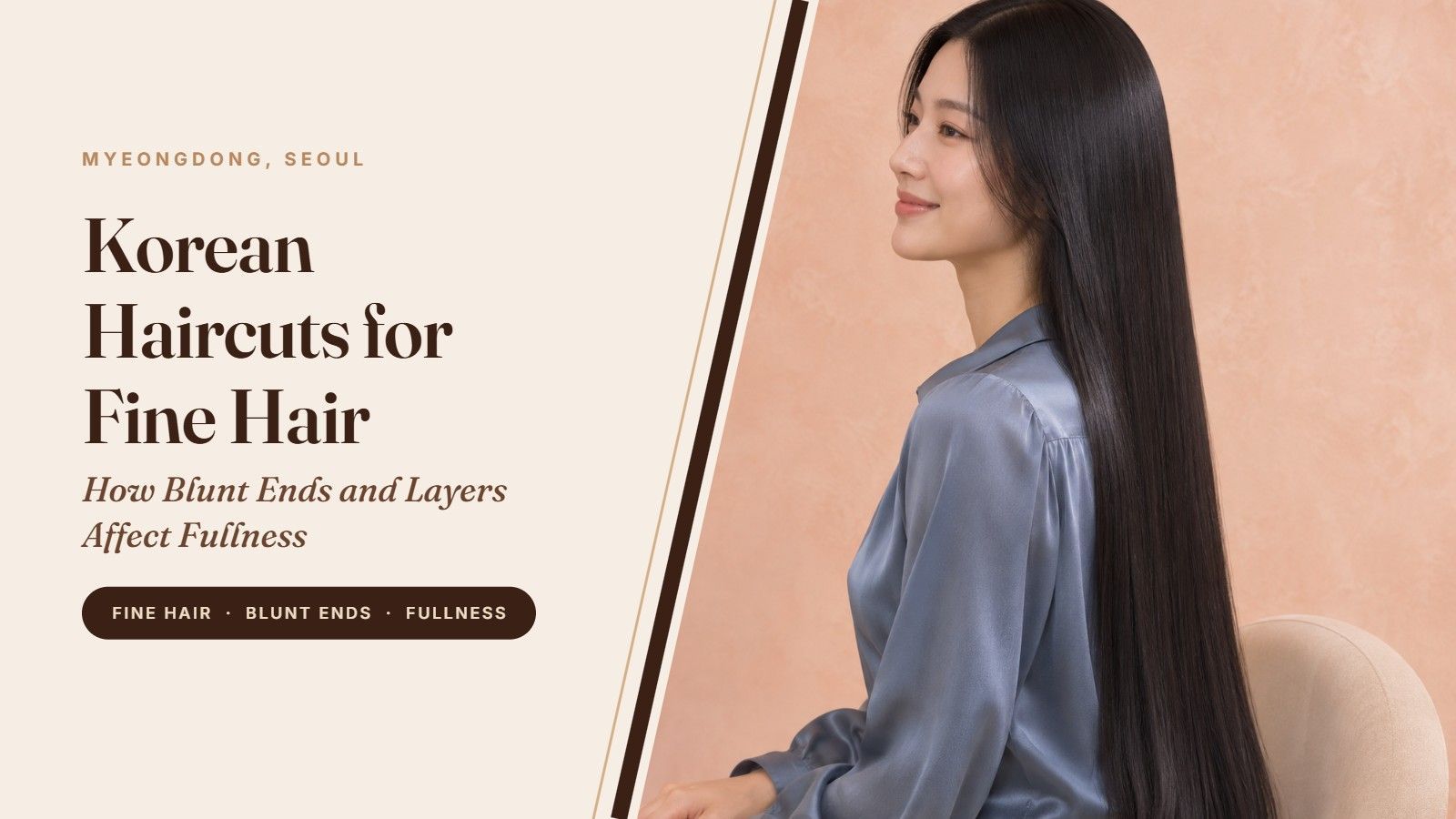
For fine hair, blunt ends make hair look fuller because all the weight sits at the bottom, while many layers can make ends look thin. The best Korean approach is a strong, blunt perimeter with only a few long or face-framing layers, little or no thinning, and volume added at the roots with styling or a soft perm.
Fine hair is about the diameter of each strand, not how much hair you have. It goes flat easily, shows every layer and can look thin at the ends if it is cut the wrong way. Korean designers have specific techniques for keeping fine hair looking full, starting with how they treat the ends. This guide explains how blunt ends and layers affect fullness, which Korean cuts work best, and exactly what to ask for at a salon in Myeongdong.
Blunt vs layered on fine hair
The most important rule for fine hair is that fullness lives at the ends. Every time a layer or thinning step removes hair from the bottom, the perimeter becomes see-through, and fine hair shows it quickly.
| Blunt ends | Heavy layers | |
|---|---|---|
| Ends | Thick, strong line | Thin, see-through |
| Volume at top | Low unless styled | More, but at the cost of ends |
| Best lengths | Bob, lob, long | Rarely ideal on fine hair |
| Overall effect | Looks thicker | Can look sparse |
This does not mean fine hair can never be layered. It means layers should be placed carefully, usually at the face or very low in the length, so the overall shape stays dense.
Fine hair vs thin hair
Fine hair and thin hair are often confused. Fine hair refers to each strand being narrow; thin hair refers to having fewer strands overall. You can have fine but dense hair, which looks full but goes flat, or coarse but thin hair, which feels strong but shows the scalp.
This matters because the solutions are different. Fine but dense hair benefits from blunt ends and root lift; it can handle a few layers. Fine and thin hair needs the most protection of the perimeter and very gentle styling. Your designer will check both in the consultation by looking at the strand and gathering the hair into a ponytail.
Where layers can go on fine hair
If you want some movement, the safest place for layers on fine hair is the face frame. A few longer pieces around the cheekbones or chin brighten the face and add softness without thinning the overall shape. Because they sit at the front, they also give the impression of more volume where people look first.
The second option is long, soft layers that start well below the chin. These add a little swing to medium and long hair while keeping the perimeter dense. Designers often point-cut these layers, snipping into the ends vertically, rather than using thinning shears, so the hair keeps its density.
Short layers at the crown, which add height on thick hair, are usually avoided on fine hair because they can stand up and look sparse. Root lift from styling or a root perm is a more reliable way to get volume at the top.
Smart layering for fine hair
Face frame only
A few front layers add movement where it shows most.
Long, soft layers
Layers that start low keep the perimeter strong.
No thinning shears
Point-cutting the edge gives softness without removing density.
Styles that look fuller
The best Korean cuts for fine hair keep a strong outline and add movement in other ways, such as a soft curl, a face frame or root volume.
Thickest-looking
One length concentrates weight.
Soft and full
A light inward curl adds body.
Length with movement
Keeps ends full.
Lift at the crown
Adds volume where fine hair flattens.
Styling fine hair for volume
- Use a lightweight shampoo Heavy, moisturising formulas weigh fine hair down.
- Condition only the ends Keep conditioner away from the roots.
- Dry upside down or with a round brush Lift the roots while they dry.
- Set with cool air Cool air locks the volume in place.
- Finish lightly A light spray or powder at the roots; avoid heavy oils.
Velcro rollers at the crown for ten minutes are one of the easiest ways to add volume to fine hair without heat damage.
What to ask for
Show this to your designer
- 모발이 가늘어서 숱은 치지 말아 주세요. My hair is fine, so please do not thin it.
- 끝선은 일자로 두껍게 남겨 주세요. Please keep the ends blunt and thick.
- 뿌리 볼륨이 생기게 해 주세요. Please help me get volume at the roots.
- Blow-dry roots upside-down or with a round brush.
- Use lightweight volumising products instead of heavy oils.
Fine hair and Korean perms
A soft perm can be one of the best things for fine hair, because the curl gives the strands body and makes them look thicker. Popular choices in Seoul include a C-curl at the ends for bobs and lobs, and a root perm at the crown for volume.
Designers usually choose a gentle formula and a slightly smaller curl than the photo, because fine hair relaxes faster. If your hair is also coloured or bleached, mention it so they can protect the strands with a treatment.
Common mistakes with fine hair
Heavy thinning
Removes the density fine hair depends on.
Many short layers
Leaves the ends wispy and see-through.
Rich oils at the roots
Makes hair flat and greasy quickly.
Large perm rods
Fine hair relaxes fast; slightly smaller curls hold better.
Keeping fine hair healthy
Fine strands break more easily than coarse ones, so heat and chemical care matter. Use a heat protectant every time you blow-dry or curl, keep tools at a moderate temperature and avoid brushing hard when hair is wet. A gentle treatment every few weeks helps keep the ends strong, which in turn keeps the blunt line looking full.
Regular trims every 8 to 10 weeks remove split ends before they travel up the strand. On fine hair, this small habit makes a noticeable difference to how thick the ends look.
Frequently asked questions
Should fine hair be layered?
Is thinning bad for fine hair?
Which Korean cut makes fine hair look thicker?
Can a perm help fine hair?
How often should I trim?
What is the best Korean cut for fine hair?
Key takeaways
- Blunt ends make fine hair look fuller.
- Limit layers to the face frame or long, soft layers.
- Avoid thinning shears.
- Add volume at the roots with styling or a soft perm.
- A blunt bob or lob is the safest choice.
Prices and times are typical ranges for Myeongdong, Seoul, and can vary by hair length, condition and designer. Always confirm the final quote in your consultation. Last reviewed November 2026.