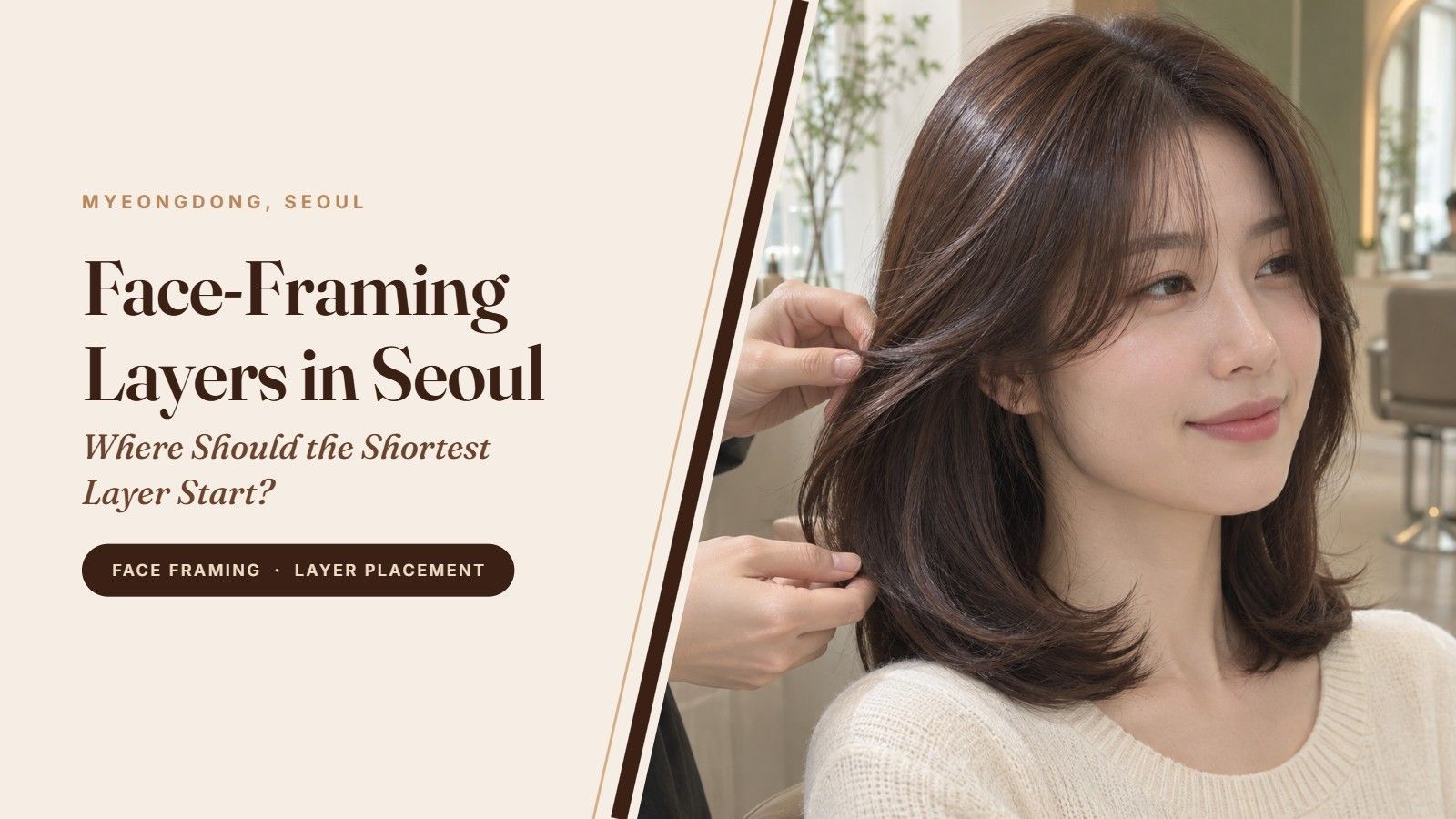
Face-framing layers are the shortest pieces cut around your face, and where the shortest one starts decides the whole look. Starting at the cheekbone gives a bold, K-drama frame that lifts the eyes; the lip or chin line flatters most face shapes and still tucks behind the ear; the collarbone is the safest choice if you want to keep length and tie your hair back. In Myeongdong, Seoul, face-framing is usually part of a designer cut (about ₩45,000–60,000, 45–75 minutes), and a good designer will check the start point on your dry hair before finishing.
Face-framing layers are the fastest way to change your look without giving up length. Two centimetres can make the difference between a soft, expensive-looking frame and pieces that feel short and choppy. This guide explains how Korean designers decide where the shortest layer should start, how that choice changes your face, what suits different hair types, and exactly how to ask for it at a salon in Myeongdong, even if you do not speak Korean.
What are face-framing layers?
Face-framing layers (얼굴 라인 레이어, eolgul ra-in leieo ) are shorter sections cut only around the front hairline: from the parting down both sides of the face. The rest of your hair keeps its length, so from behind your hair looks almost the same. From the front, the shorter pieces fall toward the face and curve softly away from it, which creates the 'framed' effect you see in Korean dramas and idol photos.
Korean salons rarely cut face-framing as a separate, blunt step. Instead, designers blend the front into long layers, curtain bangs or side bangs so that the shortest piece flows gradually into the length. That blending is why a well-cut Korean face frame looks effortless rather than 'cut on'.
Starting point
The length of the shortest piece, usually measured against a facial feature.
Gradation
How quickly the frame steps down into your full length.
Direction
Whether the ends curve toward the face (soft) or away from it (open, airy).
Of these three, the starting point is the decision you need to make yourself; the gradation and direction are usually adjusted by the designer to suit your hair.
Where should the shortest layer start?
Designers usually describe the start point using a facial feature rather than centimetres, because everyone's face is different. Here is what each common starting point does.
| Start point | What it highlights | Styling time | Grow-out |
|---|---|---|---|
| Cheekbone | Eyes and cheekbones, gives lift | 5–10 min daily | Needs a trim in 6–8 weeks |
| Lip line | Lips and smile, softens the jaw | 3–5 min | Blends in about 2 months |
| Chin | Jaw line, balanced and versatile | 2–5 min | Easy, grows into lip/collarbone length |
| Collarbone | Neck and shoulders, subtle movement | Air-dry friendly | Very easy |
Cheekbone-length frames are the most dramatic and photograph beautifully, but they need a blow-dry every day and reach an awkward in-between length the fastest. Lip to chin is the sweet spot for most people: noticeable, flattering and still long enough to tuck behind the ear. Collarbone frames are almost invisible when tied up and are ideal if you are trying face-framing for the first time.
Measure it on yourself
Before your appointment, take a strand from the front and hold it against your cheekbone, lips and chin in a mirror. Notice which length you would still like on a day when you do not style your hair. That is usually the right starting point.
How the start point changes your face shape
Face-framing works like contouring with hair: the shortest piece draws the eye to where it ends, and the curve around it softens or widens that area.
Start below the chin
Longer pieces draw the eye downward and create length. Avoid volume at cheek level, which adds width.
Start at the cheekbone
Shorter pieces add width at the sides; pairing with side bangs shortens the face visually.
Start at the lip line
Soft, inward-curving ends cover the corners of the jaw and round the outline.
Start at the chin
Adds fullness near a narrower jaw and balances a wider forehead.
Any start point
Choose by how much styling you want rather than by face shape.
Lip to chin, soft curve
A gentle curve softens bold features without hiding them.
If you are between two shapes, choose the longer option. It is easy to make a frame shorter at your next visit, but it takes months to grow a cheekbone frame back down.
Matching face framing to your hair type
Hair density and texture matter as much as face shape, because they decide whether the frame holds its curve or falls flat.
| Hair type | Best start point | Designer tip |
|---|---|---|
| Thick, straight | Cheekbone to lip | Internal thinning keeps the frame light |
| Fine or thin | Chin to collarbone | Few, long pieces so the front still looks full |
| Wavy | Lip to chin | Cut and check dry so waves sit evenly |
| Curly | Chin or longer | Cut curl by curl; curls shrink after washing |
| Coloured or bleached | Any, gently | Ask for point-cutting instead of a razor on fragile ends |
Thick hair can carry a higher start point because there is enough weight to hold the curve. Fine hair can look thin at the front if the frame starts too high, so many Korean designers keep it longer and add a soft C-curl or a quick blow-dry to create the shape instead.
Face framing with bangs, layers and perms
Face-framing rarely stands alone in Korean styling. It is usually combined with one of these, which changes where the frame should start.
- Curtain bangs: the frame continues from the bangs, so the start point is usually the cheekbone, blending into longer pieces at the chin.
- See-through bangs: a separate, longer frame (chin or lip) keeps the sides soft while the bangs sit across the forehead.
- Long layered cut or hush cut: the frame becomes the shortest layer of the whole cut, so it should match the layering style.
- C-curl perm: a light inward curl at the ends makes a frame look finished every day, especially on straight or fine hair.
If you are planning a perm, mention it before the cut. Curls make hair look shorter, so the designer may leave the frame slightly longer.
How to ask for it at a salon in Myeongdong
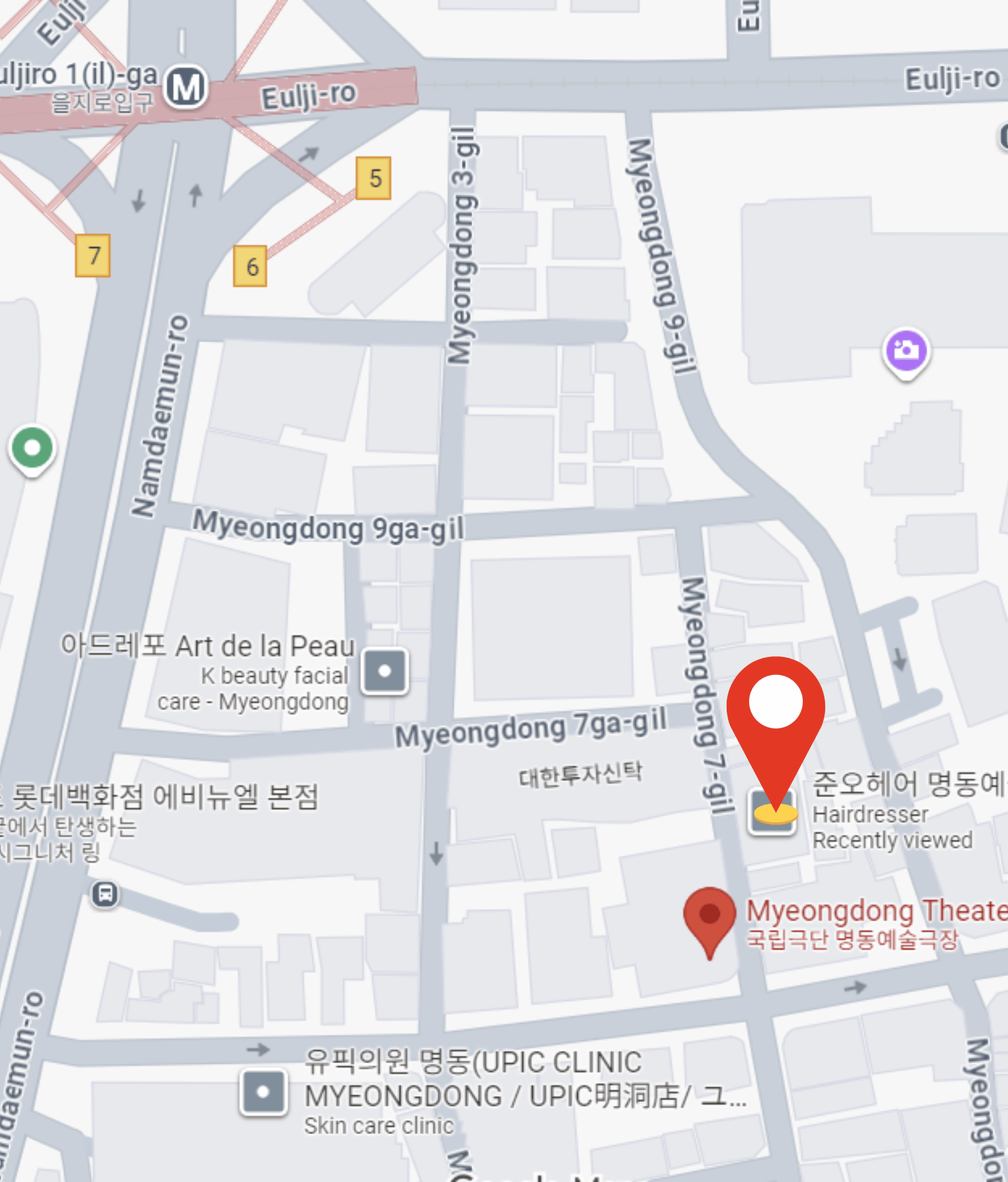
Most salons near Myeongdong Station (Line 4) and Euljiro 1-ga Station (Line 2) see international clients every day, and many have English-speaking designers. Clear photos and pointing to your own face are more useful than any hair vocabulary.
- Bring two or three photos Choose references with similar hair thickness and length, and include a side view.
- Point to the spot Touch your cheekbone, lips or chin so the designer sees the exact start point.
- Agree to start longer Ask the designer to begin slightly longer and check it dry; it is easy to go shorter.
- Mention your routine Say whether you blow-dry daily or prefer to air-dry so the frame suits your habits.
- Learn the blow-dry Ask the designer to show you how to round-brush the front at home.
Show this to your designer
- 얼굴 라인 레이어 넣어 주세요. Please add face-framing layers.
- 제일 짧은 부분은 턱선에서 시작해 주세요. Please start the shortest piece at my jawline.
- 처음이라 조금 길게 시작해 주세요. It is my first time, so please start a little longer.
- 말렸을 때 길이로 확인해 주세요. Please check the length when my hair is dry.
Common mistakes and how to avoid them
Starting too high
Cheekbone frames on fine hair can look thin. Start at the chin and adjust later.
Checking only wet
Hair rises as it dries, especially wavy hair. Always confirm the length dry.
Ignoring your part
A frame cut for a middle part falls differently on a side part; tell your designer how you wear it.
Heavy thinning at the front
Too much thinning makes the frame wispy and frizzy; ask for point-cutting instead.
Styling and grow-out tips
The shape of a face frame comes mostly from how the front is dried. Five minutes in the morning makes a big difference.
- Dry the front first, while the hair is still wet, and brush it away from the face with a medium round brush.
- Use a 32 mm curling iron on the front pieces only for a quick, polished curve.
- Velcro rollers on the front for ten minutes while you do your makeup give soft volume without heat damage.
- Trim every 6–10 weeks for cheekbone frames; chin and collarbone frames can wait 10–12 weeks.
- Growing them out? Ask your designer to blend the frame into side bangs or long layers at each trim instead of letting it hang.
Frequently asked questions
Where should face-framing layers start for a round face?
Do face-framing layers work on fine hair?
Can I still tie my hair up with face-framing layers?
How much does a face-framing cut cost in Myeongdong?
How long do face-framing layers take to grow out?
Should face-framing layers be cut wet or dry?
Key takeaways
- The starting point of face-framing layers decides which feature is highlighted.
- Chin to lip line suits most faces; cheekbone is boldest; collarbone is safest.
- Match the start point to both your face shape and your hair density.
- Point to the exact spot on your face, start slightly longer and check it dry.
- In Myeongdong, face-framing is usually part of a ₩45,000–60,000 designer cut.
Prices and times are typical ranges for Myeongdong, Seoul, and can vary by hair length, condition and designer. Always confirm the final quote in your consultation. Last reviewed November 2026.